Someone signs up expecting to learn something every week. Three months in, nothing's arrived. They stop opening the brand's emails entirely, which quietly drags down everything else those emails were supposed to do, including reminding them to reorder.
We went looking for a specific, named founder saying this out loud about a health or wellness brand. We didn't find one we could verify word for word, so we're not going to pretend we did. What we found instead, across founder interviews, forum threads, and newsletter-creator burnout posts, is a pattern that shows up again and again even without a single clean quote to pin it to: a founder launches a weekly or biweekly tips newsletter with real intent, keeps it up for a few months while things are calm, and then a launch, a supply problem, or a bad week eats the time. The newsletter doesn't get killed. It just quietly stops being anyone's job that week. Then the next week. Then it's been ten weeks and nobody sent anything.
That's the composite version of a story we couldn't attribute to one real person with confidence. But the underlying mechanic is the same one behind the softened claim already in this post, not speculation: a newsletter that goes quiet does more than miss a week of content. It teaches the subscriber to stop opening the brand's emails at all, which quietly drags down everything else those emails were supposed to do.
Why the newsletter loses every single week
A content newsletter is a retention tool that only works if it actually shows up. An inconsistent one does the opposite of its job.
Here's the mechanism, plainly: writing a newsletter from scratch takes real, uninterrupted thinking time. Not fifteen minutes, an hour or two, sourcing a tip, checking it's accurate, writing it in the brand's voice, formatting it. That block of time has to compete against restocking a bestseller, answering a wholesale inquiry, fixing a checkout bug, or any of the dozen things that feel more urgent because they have a deadline attached and the newsletter doesn't.
It's rarely a decision to stop. Nobody sits down and decides the newsletter isn't worth doing anymore. It just loses the competition for attention every week, until enough weeks have passed that starting again feels like its own project: what do we even say now, has anyone unsubscribed, do we address the gap or pretend it didn't happen.
The subscriber side of this is where it actually costs something. Missing one issue teaches a subscriber almost nothing, everyone assumes a one-off. But three or four gaps in a row retrains behavior: the subscriber stops expecting the email, which means they stop opening it, which means when it does arrive it's more likely to get skipped or marked as clutter rather than read. Email engagement is somewhat sticky in both directions. Consistent senders build a habit of being opened. Inconsistent senders build a habit of being ignored, and that habit doesn't reset just because the brand starts sending again.
This matters more for health, nutrition, and wellness brands specifically, because for a lot of these brands the newsletter isn't a nice-to-have layered on top of the product, it's part of the product experience. A supplement brand that promises dosage guidance, a skincare brand that promises a usage routine, a nutrition brand that promises ongoing education: the newsletter is where a chunk of that promised value actually gets delivered. A generic apparel brand's newsletter going quiet loses some engagement. A wellness brand's newsletter going quiet breaks an implicit promise the customer paid for.
What a solution could look like
There are a few honest paths here, and none of them is free.
Hire a freelance newsletter writer.This solves the time problem directly, someone else is now responsible for the words showing up. It doesn't solve the brand-knowledge problem. A freelancer writing for a supplement brand needs to actually understand the product line, the dosing guidance, what claims are safe to make and which aren't, and that ramp-up takes real onboarding time and ongoing correction. It also reintroduces a dependency: if the freelancer gets busy or moves on, the brand is back to square one, just with an added cost.
Use a generic AI writing tool with no brand grounding.Fast, cheap, and the output reads like it came from nowhere in particular. Ask a general-purpose tool to write a wellness tip and it will confidently generate something plausible-sounding that may not match the brand's actual formulation, dosing, or research citations. For most content categories that's an annoyance. For health and wellness content, a confidently wrong tip about dosage or interactions is a real problem, not a tone problem.
Batch several issues during a rare free week. This is what a lot of founders actually do, and it works better than nothing. The failure mode is that the batching week never arrives reliably, or when it does, the founder is exhausted and writes four rushed issues instead of one good one repeated four times. It buys a few weeks of runway without changing the underlying capacity problem.
Build a custom automated drafting-plus-review system.This is the option we'd actually build, and it's the only one of the four that addresses both the time problem and the brand-grounding problem at once, without removing human judgment from what goes out. The tradeoff is setup cost: it requires an actual content library to draft from, which most brands don't have organized anywhere.
The solution we'd build
Here's how we'd build this.
The core idea is separating two jobs that currently get bundled into one exhausting task: assembling the raw material for a tip, and deciding whether that tip is good enough to send. Right now, a founder or a marketing person does both at once, from a blank page, under time pressure. We'd split them.
The first piece is a content-source library: a structured collection of the brand's actual product information, research citations the brand already relies on for claims, past newsletter issues, FAQ answers, and customer question patterns pulled from support tickets. This is mostly stuff that already exists scattered across product pages, a Notion doc, old emails, and a founder's head, not a new asset the brand has to write from scratch. The work is centralizing it once, not maintaining a new writing habit forever.
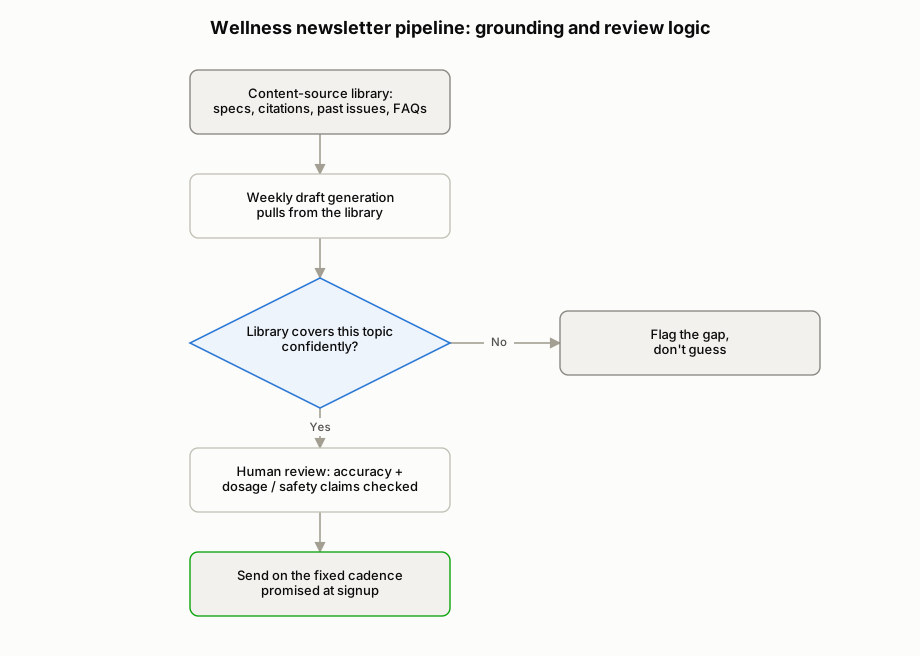
On a weekly cadence, a draft generation step pulls from that library and produces a full newsletter draft: a tip, framed the way the brand usually frames things, grounded in something that's actually in the source library rather than generated from general knowledge. If the library has a page on magnesium dosing timing, the draft references that page's specifics, not a plausible-sounding number pulled from nowhere. If nothing in the library covers a topic well, the system should say so rather than fill the gap with a guess, that's a deliberate constraint, not a limitation to work around.
Then, before anything reaches a subscriber, a human review and edit step. This is not a rubber stamp. For most content categories a light brand-voice check would be enough. For health and wellness content specifically, this step has to check something more consequential: is the dosage guidance accurate, is the usage claim something the brand can actually stand behind, does this read as medical advice when it shouldn't. That review has to be done by someone who understands the product, not just someone checking for typos.
Only after that review does the send happen, on the schedule the brand actually committed to when someone signed up. The drafting bottleneck disappears. The judgment call before it goes out stays exactly where it should, with a person.
Pros and cons, honestly
The upside is real: it removes the blank-page problem, which is the actual reason these newsletters go quiet. Nobody's staring at an empty draft on a Tuesday afternoon trying to think of something to say. A draft already exists, grounded in the brand's own material, and the work becomes reviewing and adjusting rather than originating.
But there are real costs and real limits, and we'd rather list them than pretend this is a clean win.
Health and wellness content carries accuracy stakes that most content categories don't. A brand-voice review alone doesn't cover it here: the review step has to catch factual and safety issues too, which means it needs someone who actually understands the product and the relevant claims, not just someone checking tone. That's a narrower reviewer pool than "whoever's free."
If the source library is thin, the output will be thin too, and it'll sound generic no matter how good the drafting system is. This isn't a system that manufactures expertise the brand doesn't have. It surfaces and structures what's already there. A brand with three product pages and no research citations to draw from will get three product pages' worth of newsletter content, repeated in different wording, and readers notice that faster than founders expect.
It is not zero-effort. There is still a weekly human step, reviewing, editing, sometimes rewriting a draft that missed the mark. The honest framing is that this replaces an hour or two of from-scratch writing with fifteen or twenty minutes of review, not that it replaces the newsletter process with nothing.
And it doesn't fix a brand that genuinely has nothing new to say. If the underlying issue is that the brand has covered every angle of its own product already and is running out of real content, no drafting system manufactures new expertise. It just makes existing expertise easier to turn into consistent output.
How it gets implemented
The practical shape is four pieces working together, not one big black box.
A content-source library, structured and centralized: product specifics, research citations already in use, past issues, common customer questions. This is mostly assembly work up front, pulling together what already exists rather than creating new material.
Weekly draft generation that pulls from that library on a fixed schedule, producing a complete draft rather than a set of bullet points to build from. The system should flag, not guess, when the library doesn't cover a topic well enough to draft from confidently.
A human review and edit step, sized to the actual stakes of the content category. For a wellness or nutrition brand, that review needs someone with real product knowledge checking accuracy claims, not just a once-over for typos.
A fixed send cadence, the same one that was promised at signup, so the system's whole point (showing up reliably) actually gets delivered rather than becoming one more thing that slips when the draft sits in review too long.
What the pain actually costs, and what fixing it is worth
The clearest number we have here is the one already documented for this category: a 41% higher click-through rate and a 29% higher open rate for relevant, on-topic email content compared to generic broadcasts, a widely cited figure compiled in Mailmend's 2026 email personalization roundup.
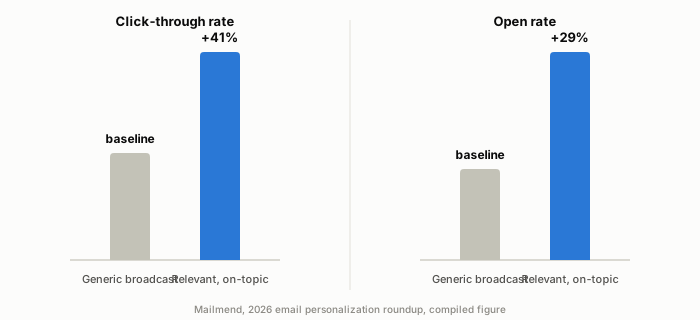
Worth repeating the hedge honestly: that's a compiled figure from a roundup, not original research Mailmend ran itself, and we're treating it accordingly rather than dressing it up as a primary study.
We didn't find additional verifiable stats specific to newsletter send-consistency and open-rate decay in health and wellness during this pass, so we're not adding anything beyond what was already fact-checked here. The honest cost of the pain, in the absence of a clean dollar figure, is the mechanism already laid out above: inconsistent sending doesn't just cost the missed issue, it trains subscribers to stop opening, and that's a harder habit to reverse than it is to prevent.