A supplement or coffee subscription is set to renew on a card that expired last month. Nobody flags it. The shipment just doesn't happen, and by the time the customer notices, they've already run out and bought a one-off replacement from somewhere else. They never technically canceled. The subscription just quietly stopped.
A founder's story
The clearest voice we found on this problem, after going through podcast transcripts and interviews, doesn't run a coffee or supplement subscription brand. It's Vijay Menon, founder and CEO of Butter Payments, a company built entirely around the fact that failed payments are not usually what they look like.
On the Subscription Stories podcast, hosted by Robbie Kellman Baxter, Menon put a number on the part of this that's easy to miss: what happens after the failure, not the failure itself.
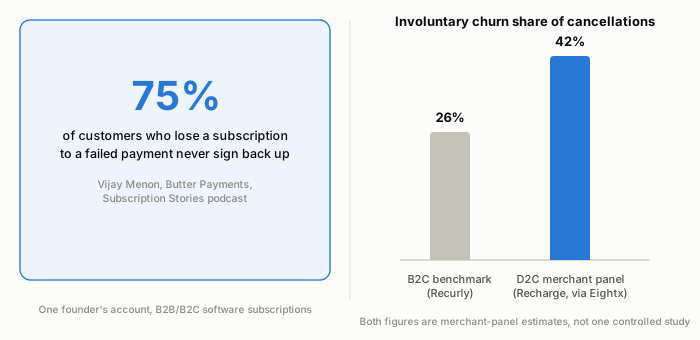
"If a user ultimately gets involuntary churn from a service, in 75% of cases they never sign back up," he said. Earlier in the same conversation, he made the case for why that's the wrong outcome for almost everyone involved: "In 70% of these cases, there is no fraud, so the company is literally turning away excellent customers."
Read that twice. Three out of four customers who lose their subscription to a failed card, not a decision to leave, simply never come back. Not because they didn't want the product. Because by the time anyone noticed, the moment to fix it had already passed, and going through a support flow to restart something they never meant to stop isn't worth the friction to most people. They just buy the coffee somewhere else next time.
Source: Robbie K Baxter, "Everything You Wanted to Know About Involuntary Churn," Subscription Stories podcast transcript, published on Medium. robbiebax.medium.com/everything-you-wanted-to-know-about-involuntary-churn
Menon's world is B2B and B2C subscription software more broadly, not specifically coffee bags and supplement pouches. But the mechanism he's describing doesn't care what's in the box. A declined charge is a declined charge whether it's renewing a SaaS seat or a bag of beans.
Elaborating the pain
An intentional cancellation is a known event. The customer clicks cancel, the brand sees it, and there's a chance to ask why, offer a pause, or just let them go cleanly. A failed payment is not that. It's a silent event that looks, from the brand's side, exactly like nothing happening at all.
That's the part worth sitting with: the brand doesn't even know it happened. There's no cancellation flag, no exit survey, no signal in the dashboard that says "this customer is now gone." The subscription just stops renewing, and unless someone is specifically watching for failed charges, the first anyone hears about it is a support ticket asking where the shipment is, weeks after the customer has already replaced the habit with something else.
Relying on the payment processor to handle this alone misses the window that matters most: before the charge fails. Most processors will retry a declined card a few times over a few days, on their own schedule, with no visibility into whether the retry actually worked or whether the customer noticed. That's useful, but it's reactive. It does nothing for the much larger and more preventable category: cards that are going to expire on a known date, sitting right there in the payment processor's own data, before a single charge attempt has failed.
There's a fulfillment-side version of this same confusion too. Ops teams plan pick, pack, and ship volume off what's expected to renew. When charges fail silently and nobody adjusts the plan, you get shipments prepped for orders that were never going to happen, or worse, a customer who updates their card a day late and gets skipped for that week's batch through no fault of their own. The payment problem and the fulfillment problem are the same root cause wearing two different hats.
What a solution could look like
There's a real range of ways brands handle this today, and it's worth being honest about what each one actually solves.
Relying entirely on the payment processor's built-in retry is the default because it's already there, no setup required. It catches some of the failures, but the retry cadence is usually blunt (a fixed schedule, not tuned to the brand or the customer), and it's reactive by definition: it only fires after the charge has already failed once.
A subscription-management platform with dunning built in (Recharge, Bold, and similar tools in the Shopify subscription ecosystem) is a meaningful step up. These platforms watch for expiring cards, send templated reminder emails, and run configurable retry sequences on decline. What they don't do well is anything outside their own rails: if the reminder needs to reference the customer's actual order history, tie into a support system, or trigger an ops-side notification about what's shipping that week, most of that either isn't there or requires stitching in more tools.
A manual process, someone on the team periodically checking the failed-charges report, works at small volume and basically nowhere else. It's the first thing to get dropped when the team is busy, which is exactly when the failed-payment backlog is growing fastest.
A fully custom automated sequence, expiring cards flagged before the charge attempt, a friendly pre-emptive reminder, a real retry sequence on failure, an ops notification tied to the same data, is the only option that closes the loop end to end. It's also the only one that requires actually building something instead of turning on a feature.
The solution we'd build
Here's how we'd build this.
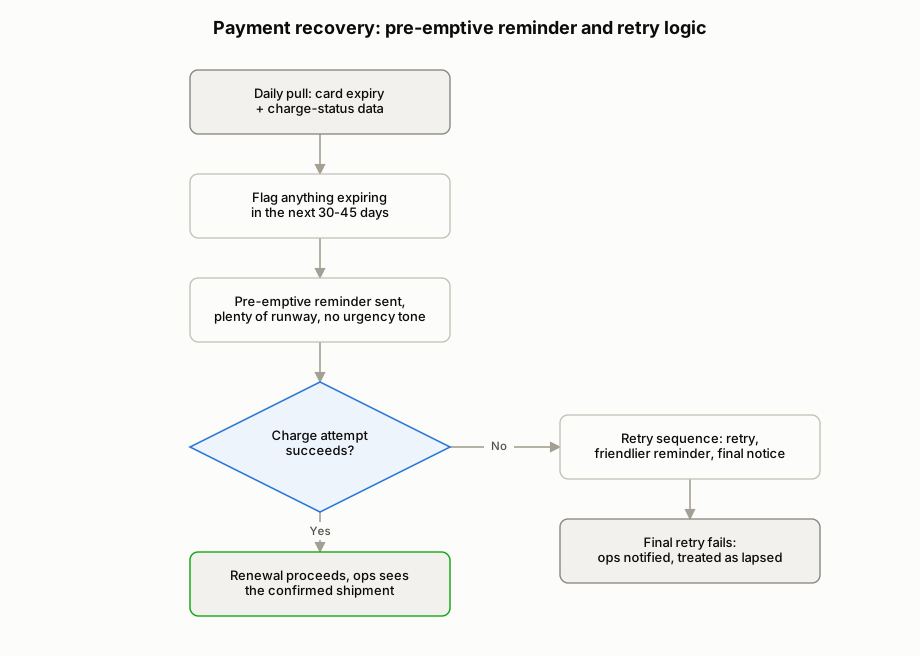
The first piece is a data pull, not a reminder system at all. Most payment processors (Stripe, Braintree, whatever the subscription platform sits on top of) expose card expiry data per customer. That data sits there unused in most setups. Pull it on a schedule, flag anything expiring in the next 30 to 45 days, and now you have a list of renewals that are going to fail before any of them actually have.
The second piece is the reminder itself, and the tone matters more than it sounds like it should. This isn't a payment-failed email, because nothing has failed yet. It's a heads-up: your card on file expires this month, here's a link to update it, no urgency language, no dark patterns. Sent with enough runway that updating it is a two-minute task, not a scramble.
The third piece is what happens if a charge fails anyway, because prevention won't catch everything. Instead of one processor-default retry and then silence, a defined sequence: retry attempt, a friendlier follow-up reminder timed to when retries actually happen, and a final notice before the subscription is treated as lapsed rather than just quietly stopping. Each step in that sequence is a chance for the customer to fix it before they've mentally moved on.
The fourth piece is the one most builds skip: an ops-facing notification. Whoever plans fulfillment for the week should see, in one place, which renewals are confirmed, which are pending a retry, and which just lapsed. That's the difference between a shipment plan built on hope and one built on what's actually going to charge.
None of these four pieces is complicated in isolation. The reason it doesn't already exist in most subscription operations is that it requires connecting payment data, a messaging layer, and fulfillment planning, three things that usually live in three different tools owned by nobody in particular.
Pros and cons
The upside is straightforward: fewer customers lost to a mechanism that had nothing to do with them wanting to leave, and a fulfillment team that's planning off real data instead of assumptions.
The costs are worth naming honestly, because they're real.
Too many retry emails start to feel like harassment, not help. A sequence that fires every day for two weeks reads as spam regardless of how legitimate the underlying problem is. The cadence has to be tight enough to catch the failure and sparse enough to not annoy someone.
This doesn't fix a customer who actually wants to cancel. Retry logic and reminder sequences are built for the accidental case. If someone's card fails because they meant to let the subscription lapse and just didn't bother formally canceling, retrying their payment is the wrong move, arguably a bad-faith one. A system like this needs a way to tell the difference, or at minimum, an easy and honest cancel path sitting right next to the "update your card" link.
It depends entirely on accurate expiry data from the payment processor. If that data is stale, incomplete, or the processor doesn't expose it cleanly, the pre-emptive half of this doesn't work, and you're back to reactive retry only.
There's a real risk of duplicate fulfillment if the timing logic has a bug. If a customer updates their card and a retry also succeeds around the same window, and the two events aren't reconciled against each other, you can end up shipping the same order twice. That's the kind of bug that shows up the first time a customer's timing happens to overlap with a scheduled retry, not a theoretical edge case.
How it gets implemented
The technical shape of this is a few connected pieces, not one big system.
A data source: the payment processor's expiry and charge-status data, pulled on a schedule (daily is usually enough) rather than waited on passively.
A pre-emptive reminder trigger: anything expiring inside a defined window gets a message queued, with the actual send timed far enough ahead that fixing it isn't a fire drill.
A retry-sequence state machine: a failed charge moves through defined states (retry pending, retry succeeded, retry failed, escalated to final notice), each with its own message and its own timing, rather than one generic "payment failed" email repeated.
A webhook or scheduled check back into the payment processor to confirm which retries actually succeeded, so the system isn't reminding someone about a card they already fixed.
An ops notification layer, feeding the same underlying data into whatever the fulfillment team already looks at, so what's shipping this week reflects what actually charged, not what was originally scheduled to.
KPIs: the cost of the pain, and the cited improvement
The most cited number here comes from software subscriptions, not physical goods, and it's worth keeping that distinction intact rather than blurring it for a cleaner story. Baremetrics' 2026 dunning management research puts industry-wide monthly recurring revenue lost to failed payments at 9%, most of it recoverable with a proper retry-and-reminder sequence instead of a single silent decline. That figure comes from SaaS subscription data. The mechanism transfers to a coffee or supplement subscription (a card that fails silently costs revenue regardless of what's renewing), but the number itself has a different origin, and we'd rather say that plainly than let it pass as directly applicable.
There is a more D2C-relevant data point worth adding. Recharge's direct-to-consumer merchant panel, cited in Eightx's 2026 DTC subscription churn index, puts involuntary churn (failed or expired cards, not intentional cancellations) at 42% of total subscription cancellations for D2C brands, compared with a narrower 26% in Recurly's broader B2C benchmark. Both are estimates built from merchant-panel data rather than a single controlled study, but the direction agrees with everything else here: a meaningful share, in some panels closer to half, of what looks like churn in a subscription business isn't a customer leaving. It's a payment that failed quietly and nobody caught in time.
And back to Menon's number, the one that should sit above all of this when deciding whether it's worth building: 75% of customers who lose a subscription to a failed payment never sign back up. Whatever the recovery rate ends up being once retries and reminders are in place, the alternative, doing nothing, means treating three out of four accidental losses as permanent.