A pattern that shows up whenever founders talk about content
We went looking for a founder quote to open this with: something specific about the exact failure mode, content written in bursts, no queue, the drop-off the moment something else demands attention. We couldn't verify one word for word from a D2C founder. What we found instead came from someone who lives this problem professionally rather than as a brand owner, and it's close enough to be worth quoting properly.
Tamilore Oladipo, a senior content creator at Buffer, described her own posting habit like this: "There were seasons when I promised I'd post every day... And then... work got busy." She put the cost of it plainly too: "trying to post daily while working full-time was a fast track to burnout" (Buffer, "I Work Full-Time, Here's the No-Pressure System That Helped Me Stay Consistent on Social Media").
That's a content professional talking about her own practice, not a founder talking about a brand. But the shape of it is the one we keep seeing, unattributed, across founder interviews and forum threads whenever the subject of social media comes up: a pattern where content gets made when there's slack in the schedule and stops the moment there isn't. Nobody decides to go quiet. It just happens, a launch or a fulfilment problem eats the week, and three weeks later nobody's written anything.
Why the gap happens and why it doesn't fix itself
Content gets written in bursts because it's rarely anyone's actual job. At a small D2C brand, it's the founder, or whoever on the team has the most spare attention that week, fitting captions and post ideas around the parts of the business that have deadlines attached: orders, fulfilment, a supplier issue, a customer complaint that needs an answer today. Social media has a deadline too, technically, but it's a soft one. Nothing breaks visibly the day a post doesn't go out.
That softness is exactly why it breaks first when something else demands attention. A queue with no runway, no posts written ahead, no ideas banked for the week someone's underwater, only survives as long as everyone stays available to write it fresh each time. The first busy week exposes that. There's nothing to fall back on, so the queue goes empty, and it stays empty until someone remembers.
"We'll post more when things calm down" is the sentence that keeps this going. Things rarely calm down in a way that produces a backlog of captions. What usually happens instead is the next busy period arrives before the last one's effects have worn off, and the gap between posts gets longer, not shorter. The team isn't lazy or undisciplined. The system just has no buffer, so every disruption shows up directly in the feed.
What a solution could look like
There's a real landscape of options here, and it's worth being honest about what each one actually solves.
A scheduling tool on its own, Buffer, Later, Hootsuite, whatever, solves the mechanical part: queueing posts to go out at set times instead of hitting publish manually. It does nothing for the actual bottleneck, which is that someone still has to sit down and write the caption, pick the image, and decide what to post about. A scheduler with an empty queue is still an empty queue, just one with a nicer interface.
Hiring a social media manager or an agency solves the writing problem by handing it to someone whose job it actually is. That's a real fix, and for a brand with the budget it's often the right one. The tradeoff is cost and onboarding: someone new has to learn the brand's voice, product line, and tone well enough to write convincingly in it, and that takes longer than founders usually expect.
Batching content once a month, a founder or team member blocking out a day to write two or three weeks of posts in one sitting, works better than bursty writing because it at least produces a runway. The failure mode here is that the batching day itself is the first thing to get bumped when the month gets busy, so the fix depends on the same discipline that caused the original problem.
A fully custom drafting-plus-scheduling automation is the option we'd build, and it's worth saying upfront what it isn't: it isn't a replacement for having a real brand voice, and it isn't zero-effort. It's a way to make sure a queue exists before someone needs it, drafted in advance, reviewed by a person, and published on a schedule that doesn't depend on anyone's Tuesday being free.
The solution we'd build
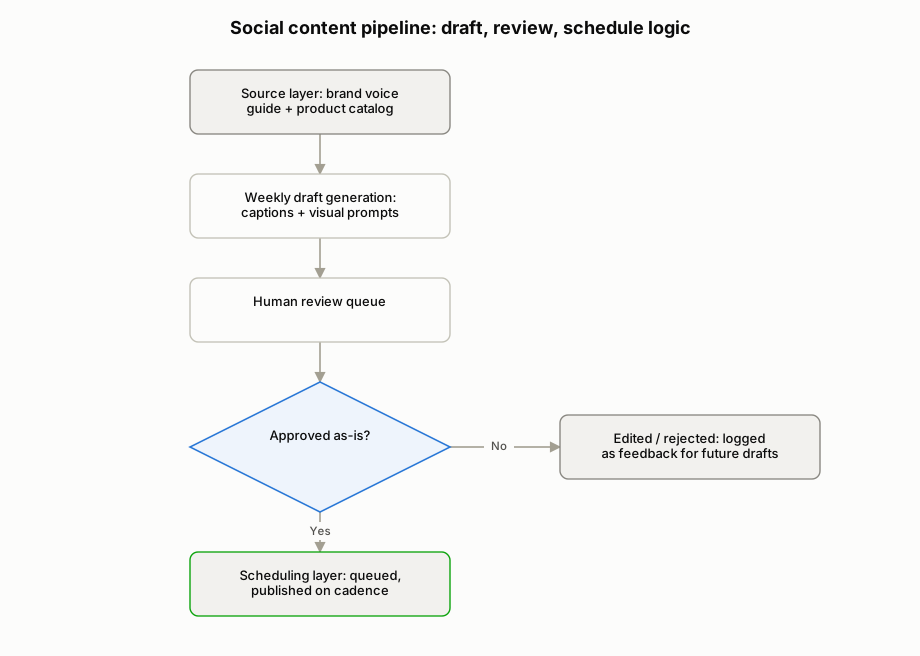
Here's how we'd build this. The core idea is simple: separate drafting from publishing, and make sure drafting happens on its own cadence, not in response to a deadline.
The system needs two sources of grounding before it writes anything. First, a brand voice reference: past captions that performed well, a style note on tone (how formal, how much slang, what the brand never says), and a list of topics that are off-limits. Second, a product and content catalog: what's in stock, what's seasonal, what's launching, and any recurring content themes the brand already leans on (room-styling shots for a home goods brand, before-and-afters for beauty, outfit posts for apparel).
On a fixed cadence, weekly is the one we'd default to, the system drafts a batch of posts for the coming stretch: captions, a content angle or prompt for the visual, and a suggested posting slot. It pulls from the product catalog for what to feature and from the voice reference for how to say it, the same grounding-before-generating pattern that keeps a system like this from drifting into generic stock-photo-caption territory.
Every draft goes into a review queue before anything is scheduled. A person looks at each one: does this sound like the brand, is the product info right, is there anything tone-deaf about posting this particular thing this particular week (a lighthearted post the same week as a shipping delay announcement, for instance). Approved drafts move to the scheduling layer and go out on the queued cadence. Anything rejected or edited gets logged, and that feedback is exactly what should tune future drafts, so the gap between AI-draft and brand-voice narrows over time instead of staying fixed.
The point isn't to remove the person from the loop. It's to make sure there's always something in the queue for that person to review, instead of a blank page the night before a post is due.
Pros and cons
The upside is straightforward: a queue that doesn't depend on anyone's bandwidth on any given day, drafted ahead of time, reviewed rather than written from scratch under pressure. That alone breaks the specific failure mode this post opened with, the gap that appears the moment something else gets busy. It also means the brand actually shows up with the kind of consistency that moves the engagement numbers cited below, not the sporadic bursts that produce one strong week followed by three quiet ones. And it takes the ambient anxiety out of the job for whoever owns social: no more staring at a blank scheduling tool on a Tuesday trying to think of something to post, because there's always a reviewable draft waiting instead of a blank page.
The cons are real and worth naming plainly. If the voice reference is thin or the tuning is skipped, the output reads generic, on-brand in structure but off in feel, and a brand's audience notices that faster than a founder writing it would expect. The review step isn't optional and isn't free: someone still has to look at every draft before it goes out, which means this system reduces effort, it doesn't eliminate it. It also doesn't fix a genuinely weak brand voice; if there's no clear point of view to draft from, automating the drafting just produces confident, well-scheduled mediocrity faster. And engagement volume isn't sales. A steady queue keeps a brand visible, which is a real and measurable thing, but visibility and conversion are different problems, and this system is built to solve the first one, not stand in for the second.
How it gets implemented
The practical shape of this is a content pipeline with four layers. A source layer holds the brand voice guide and the product catalog, kept current as new products launch or seasonal lines change. A generation layer runs on a fixed cadence, pulling from that source material to draft a batch of posts with captions and visual prompts. A review layer surfaces every draft to a person before it's scheduled, with edits and rejections logged as feedback. A scheduling layer takes approved drafts and queues them through whatever publishing tool the brand already uses.
The cadence is the part most worth getting right. Too tight, and the review step becomes its own burden, defeating the point. Too loose, and the queue runs dry between batches, which is the exact problem this is meant to solve. Weekly batching, reviewed in one sitting rather than piecemeal, tends to hold up better than either extreme, though the right interval depends on how many platforms and how much volume a given brand is actually running.
KPIs: the cost of the pain, and the cited improvement
The clearest number we have here is Buffer's 2026 analysis of over 100,000 accounts: brands that post consistently see roughly 5x more engagement per post, likes, comments, shares, than brands that post on and off.
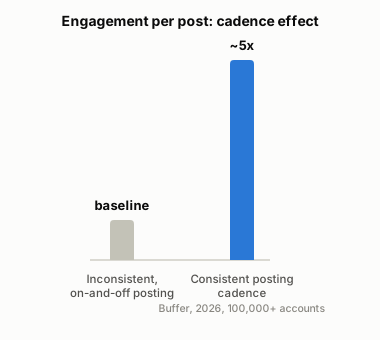
Worth being precise about what that stat is and isn't. It's an engagement number, not a sales number, and the underlying study is a three-tier comparison (highly consistent, moderately consistent, inconsistent), not a clean two-way split. Engagement isn't revenue. But it's the mechanism by which a brand stays visible enough between purchases to be the one a customer thinks of when they're ready to buy again, so it's not a disconnected metric either.
We looked for additional cited data to add here, hours lost per week to content creation, direct revenue impact of posting cadence, and didn't find anything we could verify against a primary source rather than a marketing blog reciting an unlinked "study." So that's the one number in this post, and it stays hedged the way it should be.
Where this shows up in practice: beauty and cosmetics brands, fashion and apparel (where the same logic extends to hashtag scheduling), and home goods, where the content itself is usually room-styling and inspiration shots rather than product photography. The category changes what gets drafted. The underlying failure mode, content that only gets made when someone has a free hour, is the same wherever a brand depends on social presence to stay in a customer's memory between purchases.