The story we couldn't verify, and the pattern that replaces it
We went looking for a founder on record saying, more or less, "our quiz leads went cold because nobody followed through on the answers." We searched podcast transcripts (Shopify Masters, Mixergy), Indie Hackers threads, Starter Story interviews, and the Shopify and ecommerce forums on Reddit. We didn't find a clean, verbatim quote that names this exact failure. We're not going to invent one and put a real name on it.
What we found instead was a gap. Founders who talk publicly about their quizzes, Primally Pure's Bethany McDaniel among them, describe the mechanics in real detail: how many questions, the persona built for each result, the email sequence tied to that persona. What almost nobody describes on record is the other version of the story, where that follow-up never gets built, the results page loads, and nothing downstream happens. That absence is its own kind of evidence. The quizzes that worked get a podcast episode. The ones that quietly became a lead form with extra steps don't.
So here's a composite scenario, not attributed to any real person, built from a pattern that shows up across founder interviews and quiz-tool case studies rather than from one specific source: a DTC founder pays for a quiz builder, spends a week getting the questions right, launches it, and watches completions climb. A couple of months in, someone asks what actually happens to the emails the quiz is collecting. The honest answer is that they sit in an export, get uploaded to the email tool as one more list, and get whatever generic welcome sequence every other signup gets. The plan or product match promised on the results page never arrives as a separate, personal follow-up. The quiz tool made the quiz easy to build and left the rest as an exercise for later, and later never quite arrives, because there's always something more urgent than wiring up a system for a lead magnet that's already "working" by the metric that gets watched, which is completions, not what happens after.
Why a results page isn't a personal experience
A quiz results page reads as personal because it uses the word "your": your skin type, your room style, your plan. But structurally it's the same page every person in that bucket sees. Answer the same five questions the same way, and two different customers land on identical text, identical product grid, identical everything. That's not a criticism of the quiz, buckets are how quizzes work, it's a description of what the results page actually is: a smarter filter, not a person paying attention.
The customer doesn't experience it that way in the moment. They spent two or three minutes answering questions about their skin, their goals, their space. That's a small act of trust, information handed over on the assumption that someone, or something, is going to do something with it. When the next thing that arrives in their inbox is a generic newsletter with no reference to anything they just told the brand, the gap between what was promised (a plan, a match, a recommendation built for them) and what showed up (the standard welcome flow) is obvious to them even if it's invisible on the brand's dashboard.
This is where quiz leads actually go cold, and it's not at the moment the tab closes. It's a few days later, when the follow-up that should reference their specific answers either doesn't exist or is close enough to generic that it doesn't read as a follow-up at all. The lead isn't lost because the customer forgot about the brand. It's lost because the brand never gave them a reason to remember it was personal.
What a solution could look like
There are roughly three ways brands handle this, and it's worth being honest about what each one actually solves.
A quiz tool with a static results page.Outgrow, Typeform, Interact, most of the Shopify quiz apps in this category. These are genuinely good at the quiz itself: branching logic, decent design, an email capture step. What they don't do out of the box is decide what happens next. The results page is often the end of the built-in logic. Anything past it, an automated email built around that specific result, a real product match instead of a persona label, has to be wired up separately, and in our experience that separate step is the one that gets skipped when the quiz ships under a deadline.
A manual review process.Someone, usually a founder or a marketing hire, checks quiz submissions periodically and follows up by hand for the ones that look promising, usually working straight from the quiz tool's own submissions dashboard or a spreadsheet export rather than any dedicated tool built for this step. This actually produces a genuinely personal response when it happens, because a person read the answers and wrote something specific. The problem is consistency. "Periodically" means the customer waits days, sometimes longer, for a plan they expected within minutes of finishing the quiz. And it doesn't scale. The tenth quiz submission of the day gets less attention than the first, not because anyone decided that, but because attention is finite and manual review doesn't scale with completions the way the quiz itself does.
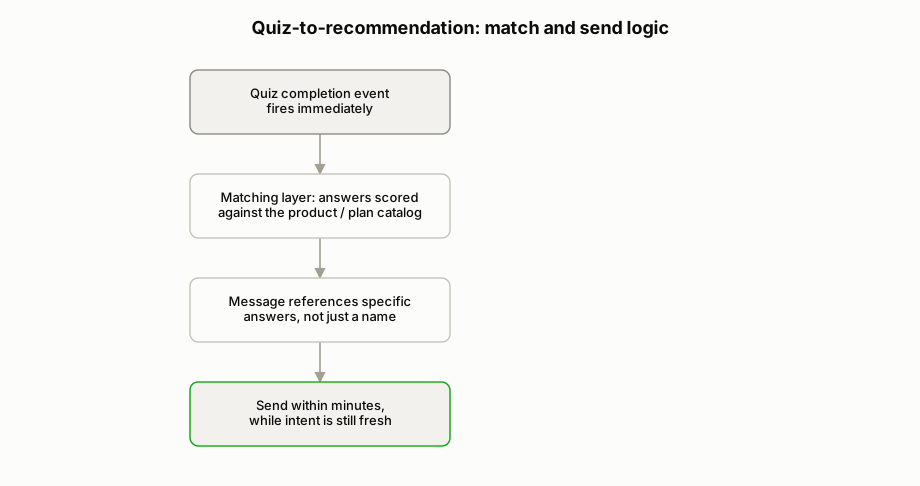
A fully automated match-and-send system.Quiz completion triggers logic that matches the specific answer combination to specific products or a specific plan, and a personalized send goes out within minutes, no person in the loop. In practice this usually means wiring the quiz tool's webhook or Zapier connector into an email platform like Klaviyo, or into a workflow tool like n8n, since there isn't a dedicated off-the-shelf category for quiz-to-recommendation matching the way there is for review requests or cart recovery. This is the version that actually closes the gap between what the quiz promises and what the customer receives, but it's also the version that requires the most upfront work, because the matching logic is only as good as the product or plan data behind it.
The solution we'd build
Here's how we'd build this, if we were doing it for a brand running a wellness quiz or a room-style quiz today.
The trigger is quiz completion itself, not a scheduled batch job. The moment someone submits their last answer, that submission needs to land somewhere a workflow can act on it immediately, whether that's a webhook from the quiz tool, a form submission event, or a row appended to a sheet that a workflow is watching. The specific mechanism matters less than the principle: the clock starts at completion, not at the next time someone checks a dashboard.
The matching logic is the part that actually determines whether this works. A quiz with five questions and three possible outcomes doesn't need much: a simple decision tree or lookup table mapping answer combinations to a small set of products or a plan template covers it. A quiz with more granular questions, skin concerns plus skin type plus budget plus fragrance preference, for example, benefits from a proper matching layer: score each product against the customer's answers on the dimensions that matter, and recommend the top matches rather than a single fixed bucket. We'd build this as a distinct step from the send, not baked into an email template, because the matching logic is the thing that needs testing and iteration as the product catalog changes, and it shouldn't be buried inside marketing copy.
The personalization has to reference specifics, not just reuse the customer's name. "Based on what you told us about your dry skin and fragrance sensitivity, here are the three products most people with your answers end up using" reads as a real match. "Hi Sarah, here's your personalized plan!" followed by the same three products everyone in that quiz result gets is a results page with an extra step, and customers notice the difference even if they can't articulate why one felt considered and the other didn't.
Timing matters more than most brands treat it as mattering. Minutes, not days. The customer is still holding the intent that made them take the quiz in the first place. A recommendation that arrives an hour later rides that intent. One that arrives three days later is competing with everything else that's happened in the customer's inbox since.
Where this breaks down: the honest cons
This isn't a clean win, and it's worth being specific about where it actually falls short.
The matching logic is only as good as the product or plan data behind it. If the underlying catalog is thin, three deodorant scents mapped to twelve possible quiz outcomes, the "personalized" recommendation is still a generic bucket wearing a personal-sounding email. Automating the send doesn't fix a matching problem; it just delivers the generic bucket faster.
There's a real risk of the recommendation feeling more robotic than the manual version it replaced, not less. A templated email that inserts {{first_name}} and {{quiz_result}}into an otherwise fixed structure can read as more impersonal than a founder manually typing three sentences, even though the automated version arrives faster and more reliably. More automation doesn't fix it. Writing the templates so the variable content actually changes the substance of the message, not just the greeting, does.
And none of this fixes a quiz that's asking the wrong questions. If the quiz collects answers that don't actually map to meaningful differences in the product catalog, automating the follow-up just automates a bad match faster. The matching system assumes the questions were designed to produce distinguishable outcomes. When they weren't, the problem sits upstream of anything a workflow can solve.
How it actually gets built
The practical shape is a three-part chain: a trigger, a matching step, and a send.
The trigger is the quiz completion event itself, captured via whatever integration the quiz tool exposes (webhook, Zapier-style connector, or a polling check against a spreadsheet or database the quiz writes to). This needs to fire on every completion, not a subset, so nothing falls through based on which answers someone gave.
The matching step takes the raw answers and runs them against a lookup table or scoring model that reflects the actual product catalog or plan library, kept current as the catalog changes. This is the piece that needs the most maintenance over time: new products need to enter the matching logic, discontinued ones need to leave it, and the mapping needs periodic review against what's actually converting, not just what seemed like a sensible pairing when it was built.
The send is the personalized email or message, built from a template that pulls in the specific matched products or plan elements, not a static block of text with a name swapped in. Whatever channel the brand already uses for transactional email (Klaviyo, the platform's native email tool, or a dedicated automation layer) is the right place for this to live, so it inherits the deliverability and unsubscribe handling the brand already has in place rather than running as a separate, unmanaged system.
What the pain costs, and what the one data point says
We don't have a broad dataset on how much revenue sits uncollected in quiz answers that never got a real follow-up. What exists publicly is a single, specific number: a 36% increase in conversion rate that one bicycle brand saw after adding a product recommendation quiz with automated follow-up, cited in Outgrow's research on quiz-driven ecommerce conversion.
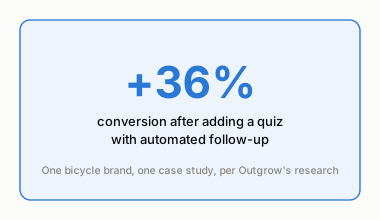
That number needs the same hedge every time it gets used. It's one case study, one brand, one product category. It isn't a controlled test that isolates follow-up as the specific variable driving the lift, the quiz itself, the products involved, and the brand's existing audience all played some role too. Treat it as directional: a signal that closing the loop between quiz answers and what a customer actually receives correlates with better outcomes in at least one documented case, not proof that any brand adding automated follow-up should expect a 36% lift of their own.
What we can say with more confidence, because it doesn't depend on any one brand's numbers, is the structural point this whole post rests on: a quiz that collects specific answers and then sends something generic is doing the hard part (getting the customer to hand over information) and skipping the part that makes that information worth anything.