A pattern that shows up across founder interviews
We couldn't find one verifiable, on-the-record quote from a single named founder telling this exact story start to finish, so we won't manufacture one and put words in someone's mouth. But the shape of the story repeats often enough across founder interviews, forum threads, and podcast transcripts that it's worth describing honestly as a composite, not a single sourced anecdote.
It goes roughly like this: a small team ships its first few hundred orders. Somewhere around month three, someone notices the product page has a rating badge with three reviews on it, all from friends and family who ordered in week one. New traffic is converting worse than it should, and nobody can prove the product is good because nobody's asked the people who already own it. So someone on the team starts manually emailing past customers, a handful at a time, whenever there's a spare hour. It works a little. It also stops the moment that person gets pulled onto something else, which is most weeks.
That gap, between "we know reviews would help" and "we have a system that reliably produces them," is the actual problem this piece is about. Not the value of reviews, which nobody seriously disputes. The mechanism for getting them.
Why manual, one-at-a-time asks don't hold up
A founder or a support hire sending review requests by hand runs into three problems that don't show up until volume increases.
First, it doesn't scale with orders. Fifty orders a month, a person can keep up. Five hundred, and review requests become the task that gets skipped whenever anything more urgent shows up, which is always. The backlog is really customers who quietly never got asked, not reviews owed.
Second, timing is almost impossible to get right by hand. Ask before the product has arrived, or before there's been time to actually use it, and you get a rushed, thin review, or no response at all. Ask weeks after delivery and the experience has gone cold. The customer's already moved on, the specific thing they liked or didn't isn't fresh anymore, and the response rate on a request sent that late drops hard. There's a real window here, tied to delivery, not to order date, and a person manually working through a list has no reliable way to hit it order after order.
Third, and this is the part that's easy to underrate: a new visitor to the product page doesn't trust the brand's own description of itself. That's just how buying decisions work when you can't touch the product, not cynicism. Someone else's account of using it, especially with a photo attached, carries weight that brand copy structurally can't, because the brand has an obvious reason to oversell and a reviewer mostly doesn't. A page with real reviews on it is doing work a product description never can, which is exactly why the PowerReviews conversion number below is as large as it is.
What a solution could look like
There's a real landscape of options here, and none of them is wrong, they solve different amounts of the problem.
A dedicated review-collection tool (Yotpo, Judge.me, Okendo, and others in that category) handles the mechanics well: automated request emails, a review widget, some UGC display features. What it doesn't solve on its own is the judgment layer: when exactly to send, what to do with a product that needs a bit of instruction before someone can review it fairly, how to avoid asking the same customer twice across different tools if the store runs more than one.
Stuart Arsenault, co-founder and CEO of the reviews platform Junip, put his finger on why so many of these setups underperform even with good tooling in place: "Due to the tools that have existed, reviews are done wrong in so many ways that end up limiting growth" (interview with Skio, skio.com). His point wasn't that the tools are bad, it's that most brands run them on default settings, generic timing, generic ask, same email for every product category, which leaves most of the tool's actual value on the table.
Manual, one-email-at-a-time collection is the starting point almost every brand begins with, described above. It works at small volume and breaks down exactly where growth starts to matter.
Occasional incentivized campaigns (a discount code for anyone who reviews this month) produce a burst of reviews and then go quiet again. They also carry real compliance exposure if not handled carefully, more on that below.
A fully automated, delivery-triggered request sequence is the version that actually holds up as volume grows, because it removes the "someone has to remember to do this" step entirely.
The solution we'd build
Here's how we'd build this, and it's a narrower system than it sounds.
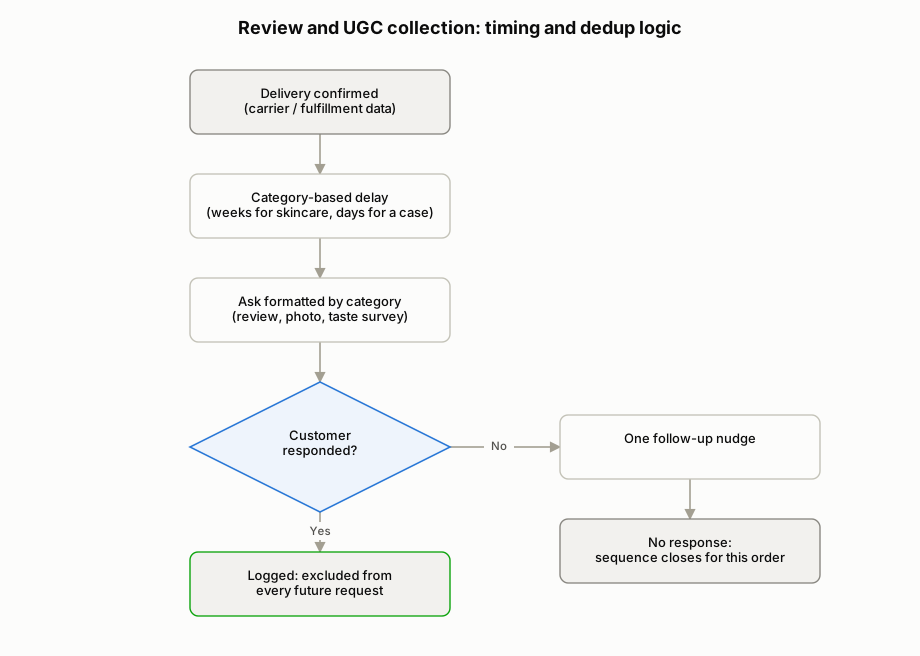
The trigger is delivery confirmation, not order date. Shipping time varies by product and by carrier, so anchoring the countdown to "order placed" means some customers get asked before the box has even arrived. Anchoring to delivery data (from the shipping carrier's tracking status or the fulfillment platform) means the clock starts when the customer actually has the product in hand.
From there, a delay before the first ask, tuned to the category. A skincare brand needs a couple of weeks before a customer has a real opinion. A phone case, a couple of days is plenty. This delay is set per product category, based on how long it actually takes someone to form an opinion worth reading, not guessed at.
The ask format changes by category too, and this is where a generic review-request email undersells what's possible. A beauty brand asks for a photo alongside the star rating. A food and beverage brand runs something closer to a taste survey. A home goods brand, especially anything that needs assembly, sends a short usage or assembly guide first, then follows with the review ask once there's been time to actually use the thing, not fight with an instruction sheet.
One follow-up, not a drip campaign. If someone hasn't responded after the first ask, one polite nudge, then the system stops. Every customer who's already responded, whether they left a review or explicitly declined, gets excluded from every future request for that order. That dedup logic sounds minor. It's the difference between a system that feels considerate and one that feels like being spammed, and it's usually the first thing that breaks when review requests are stitched together across multiple tools or manually tracked in a spreadsheet.
Pros and cons, honestly
The upside is straightforward: consistent proof accumulating on product pages without someone having to remember to chase it, timed to when customers are actually able to give a useful answer, in a format that fits the category instead of a generic star-rating ask.
The cons are real and worth stating plainly, not softened.
Incentivized reviews can skew the picture toward positive if they're not handled correctly, and under the FTC's 2024 Trade Regulation Rule on the Use of Consumer Reviews and Testimonials, businesses are prohibited from conditioning an incentive on what the review actually says, positive or negative (Holland & Knight's summary of the rule, hklaw.com). A discount code for "leaving a review" is fine. A discount code for "leaving a five-star review" isn't, and the rule has real penalties attached.
The whole system depends on accurate delivery-confirmation data. If carrier tracking is unreliable for a given shipping method, or delivery events don't fire cleanly into whatever system is watching for them, timing goes wrong and the rest of the sequence inherits that error.
Review fatigue is a real risk if the sequence isn't tuned. One well-timed ask reads as reasonable. A brand that also runs email marketing, SMS, and an unrelated loyalty program can easily stack requests onto the same customer without anyone noticing until unsubscribe rates move.
And none of this fixes a product that genuinely disappoints people. Automating the ask makes it more likely an honest review gets left. It has no opinion on whether that review is good.
How it gets implemented
The shape of the build, without the sales pitch: a delivery-confirmation event (from a shipping/tracking integration or the fulfillment platform) starts a per-order timer. A category-based delay table decides how long to wait before the first ask, and a category-based template decides what that ask looks like, review, photo, taste survey, before-and-after, or usage-guide-then-review. A dedup layer checks whether this order, or this customer for this product, has already been asked or already responded, and skips the send if so. One retry after a set number of days for non-responders, then the sequence closes out for that order regardless of outcome. Incentive logic, if used, is disclosed to the customer and never conditioned on review sentiment, and the reward triggers off submission, not content.
None of this requires a large system. It's a handful of triggers, a lookup table for timing and format by category, and a dedup check that has to actually be enforced, not just intended.
The numbers
52.2% conversion lift on a product page once it has one or more reviews, compared to none, per PowerReviews' research on review volume and conversion impact.
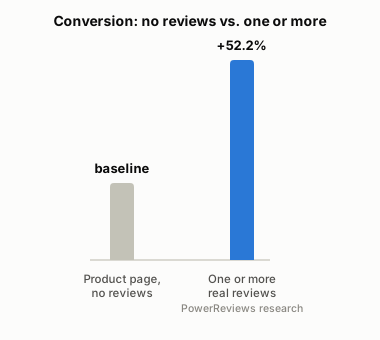
That's the single most consistent stat across every vertical we've researched in depth: beauty (photo requests), fashion (UGC campaigns), food and beverage (taste surveys), health and wellness (before-and-after stories), and home goods (assembly-guide-plus-review). The ask format changes to fit what "proof" means in that category. The underlying mechanism, and the fact that it has to run automatically rather than occasionally, doesn't change at all.
The cost of the pain isn't a number we can cite cleanly (it's the reviews that never got asked for, which by definition don't show up in anyone's dataset). What's measurable is the other side: a product page with real proof on it converts meaningfully better than one without, and that gap opens the moment the first honest review lands, not after the hundredth.