We went looking for a founder who'd said this out loud, on record, about a specific brand. We checked podcast transcripts, Starter Story interviews, Indie Hackers threads, and forum posts from people running furniture and appliance DTC brands, looking for a verbatim, sourced quote about phone-tag delivery scheduling. We didn't find one we could verify by fetching the source ourselves, so we're not going to invent one and put a real person's name next to it.
What we can describe instead is a pattern that shows up repeatedly in how operators talk about this problem, even without a single quotable line to point to: a founder scaling from a few dozen orders a week to a few hundred, watching second-attempt delivery costs climb, and realizing the actual failure point sits before the courier ever gets involved, in the scheduling step itself. Someone on the ops team is calling or emailing customers one at a time to find a window that works, and every step in that back-and-forth is a place for the order to slip: a missed call, a misheard date, a customer who confirms a time and then forgets it by the time the truck shows up. None of that is a lie, it's a composite built from how this problem gets described over and over in ecommerce operator circles. We're labeling it as such rather than dressing it up as a quote.
Why this pain is real even without a named source
Large or bulky items can't just get left at the door. A sofa, a refrigerator, a washing machine, these need someone home to receive them, sometimes to sign for them, sometimes to help carry them in. That single fact changes the entire delivery problem. A small parcel that misses its recipient gets left in a safe spot or with a neighbor. A three-seat sectional does not.
So bulky-item delivery depends on a specific person being in a specific place at a specific time, which means it depends on scheduling working correctly before the truck ever leaves the depot. Most brands still solve that scheduling step with people: someone calls the customer, or the customer calls in, and they go back and forth until they land on a window. That process is slow, and worse, it's fragile. A number gets copied wrong. A callback doesn't happen because the ops person got pulled onto something else. A customer picks "Tuesday afternoon" verbally and nobody puts it anywhere the warehouse can see.
Every one of those small failures turns into the same outcome: a truck shows up, nobody's home, and now there's a second delivery attempt to schedule, which costs real money in fuel and driver time, and a customer who's now had two bad experiences with a purchase they haven't even touched yet. The frustration compounds, because the customer didn't cause the miscommunication and still has to absorb the delay.
What a solution could look like
There isn't one obvious fix here, there's a spectrum of them, and it's worth being honest about what each one actually solves.
The default is the manual call-and-email loop most brands already run. It works, in the sense that a person eventually gets a time. It doesn't scale, because every order needs a human doing coordination work that doesn't get faster as volume grows, and it's the version most exposed to the small errors described above.
Some couriers offer their own delivery-window system built into their tracking or booking flow. This removes the phone tag, which is real progress, but the windows are often broad (a four-hour block, sometimes a full day) because the courier is optimizing for their own route density, not for the specific customer's schedule. It reduces missed deliveries somewhat without actually solving the precision problem.
White-glove delivery services solve this by taking over scheduling entirely, calling the customer, confirming a tight window, sometimes even handling in-home placement and packaging removal. This genuinely works well. It also costs more per delivery, which only pencils out for higher-ticket items or brands with the margin to absorb it, and it puts the brand's delivery experience largely in a third party's hands.
Then there's a fully custom, self-service scheduling flow built directly into the brand's own order pipeline: the customer gets a link, picks their own window, and the system handles confirmation and follow-up without anyone on the ops team touching it. This is the option we'd build, and it's worth being specific about why.
The solution we'd build
Here's how we'd think about building this, at the level of what actually happens and in what order.
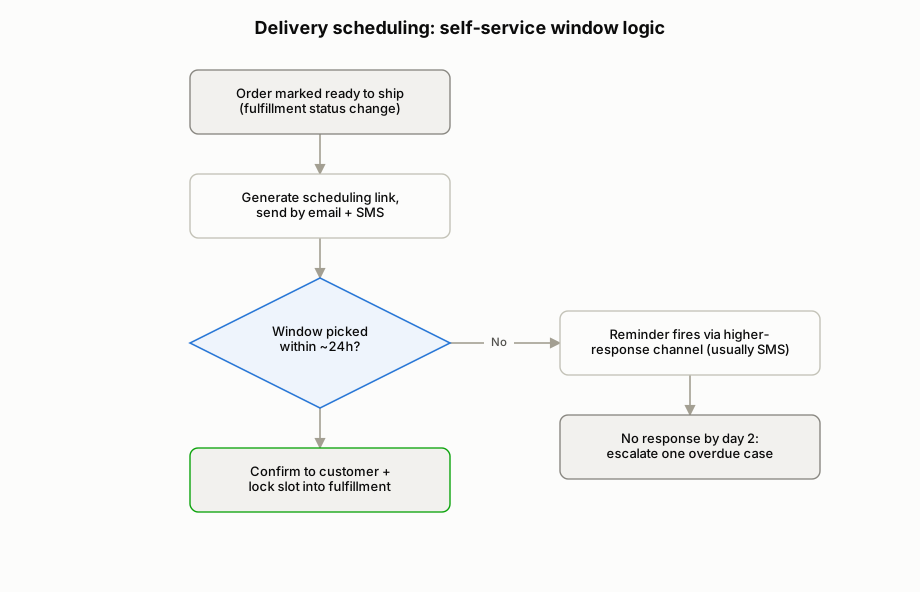
The trigger is order-ready status, not order-placed. The moment fulfillment marks an order as ready to ship (inventory picked, packed, staged for the delivery leg), that status change fires a webhook. That timing matters: send the scheduling link too early and the customer picks a date the warehouse can't actually hit yet, send it too late and you've reintroduced the delay you're trying to remove.
That webhook triggers an automation that generates a scheduling link tied to that specific order and sends it by email and SMS. The link opens a simple interface: available delivery windows, pulled either from the courier's real-time slot API if one exists, or from a manually maintained calendar of realistic windows if it doesn't. The customer picks one. No login, no account creation, just an order reference and a choice.
Once a window is picked, two things happen automatically. First, a confirmation goes out immediately, to the customer and to the internal fulfillment system, so the warehouse and the delivery leg both see the same locked-in time without anyone re-entering it by hand. Second, that confirmed slot gets written back into whatever system triggers the actual dispatch, so there's one source of truth for the appointment instead of a time living in someone's email thread.
The part that actually removes the phone tag is the follow-up logic. If nobody's picked a window within roughly 24 hours of the link going out, a reminder fires automatically, by whichever channel got the higher response rate historically (usually SMS for this kind of nudge). If a second day passes with no response, that's when it escalates to an actual human on the ops team, who now has one specific overdue case to call instead of running scheduling for every order by default. The system handles the cases that don't need a person, and routes the ones that do to someone with the context already attached.
Pros and cons, honestly
The upside is straightforward: customers pick their own window instead of playing phone tag, ops time shifts from coordinating every order to handling the exceptions, and there's a single confirmed record of the appointment instead of a note in someone's inbox.
The cons are just as real, and we'd rather state them plainly than gloss over them. This entire approach depends on the delivery carrier or 3PL actually exposing real-time slot availability through an API. A lot of them don't, especially smaller regional carriers that bulky-item brands often use for last-mile delivery. Without that, you're back to a manually maintained calendar of windows, which is better than phone tag but isn't the same as true real-time availability, and someone still has to keep that calendar current.
It also doesn't fix an unreliable carrier. If the truck is still late or the driver still shows up outside the confirmed window, a beautifully scheduled appointment doesn't help, the customer still had a bad experience, they just had it after confirming a time instead of guessing one. And it doesn't touch the underlying last-mile logistics problems, route density, driver capacity, depot location, that cause a meaningful share of failed attempts in the first place. Scheduling and routing are solving different halves of the same failure, and building the scheduling half well doesn't make the routing half go away.
How it gets implemented
At a system level, this is three connected pieces, not one big build. An order-ready trigger, usually a webhook from the order management or fulfillment system, kicks off the flow. A slot-availability layer sits underneath it: real-time via the carrier's API where that exists, a manually maintained fallback calendar where it doesn't, with a flag somewhere in the system so the team knows which mode any given order is running in. And a confirmation and reminder layer handles the messaging: immediate confirmation on booking, a reminder at the 24-hour mark if no window is picked, and an escalation to a person after that.
The fallback calendar matters more than it might sound like. Most bulky-item brands, especially ones running through regional or contracted couriers, won't have a clean API to plug into on day one. Building the manual-window version first, and treating the API integration as an upgrade path rather than a prerequisite, is usually the more honest way to sequence this.
What this actually costs, and what's actually been shown to help
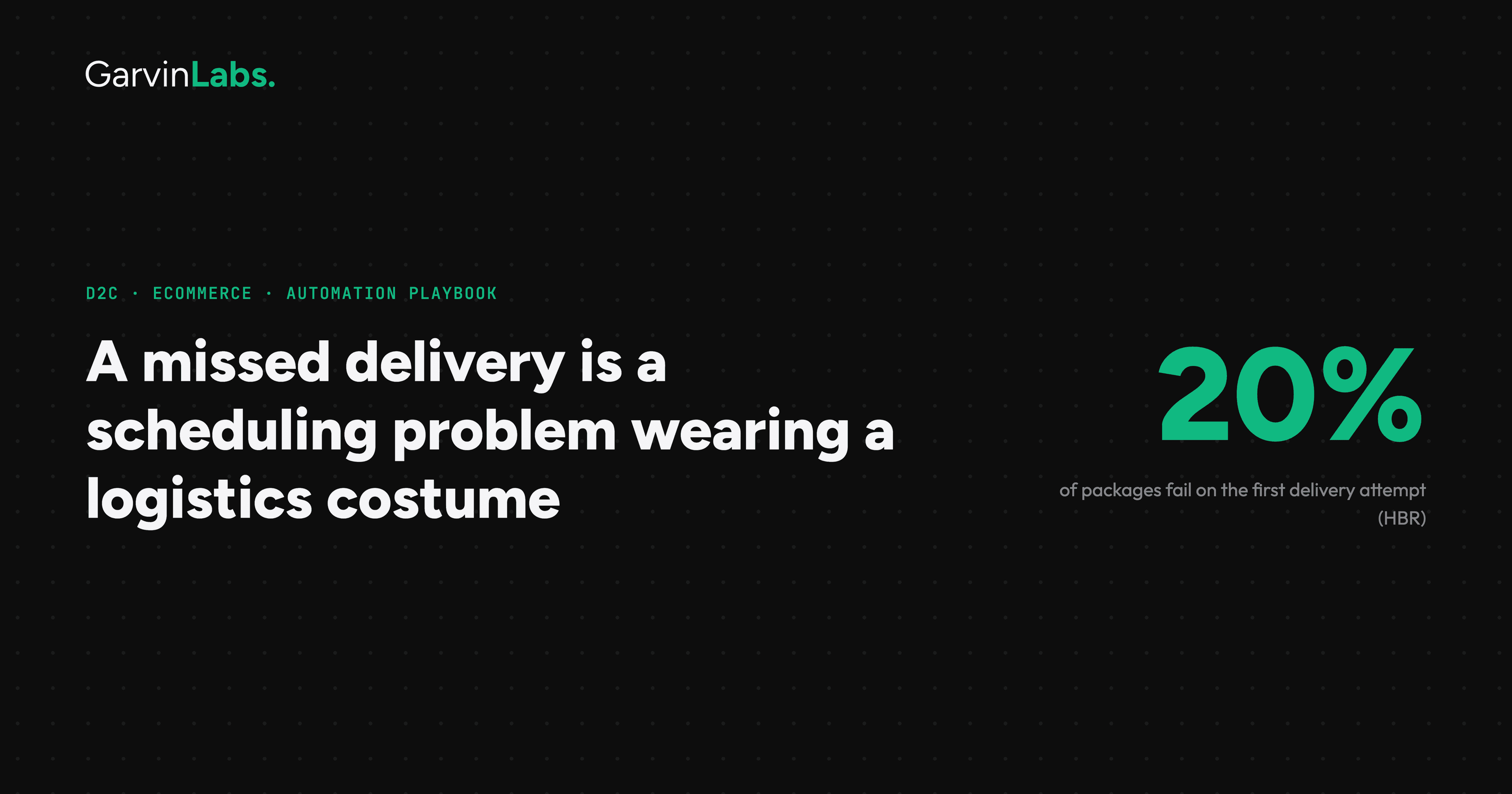
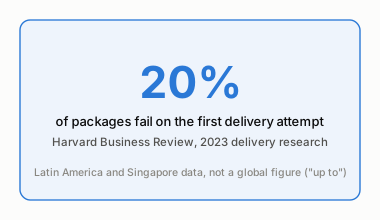
The number worth grounding this in comes from Harvard Business Review's 2023 research: up to 20% of packages fail to reach recipients on the first delivery attempt. That figure is drawn from delivery data in Latin America and Singapore, not a global industry census, so we're not calling it an industry-wide number, it's a documented failure rate in those specific markets.
The research itself points to smarter route planning as the fix, not customer-facing scheduling tools. We haven't found data that proves a self-service scheduling link reduces that specific failure rate, so we won't claim it does. What we'll say instead is that the two approaches attack the same failure from different ends: better routing gets the truck to the right place at the right time, and a recipient who picked their own window is more likely to actually be home when it arrives. They're complementary, not substitutes, and treating either one as the whole fix undersells the problem.
This pattern is documented in home goods specifically, where bulky items make phone-tag scheduling especially costly, but the same logic holds anywhere a delivery needs a specific window and a person present to receive it: furniture, appliances, anything too large to leave at the door.