We went looking for a founder on record describing this exact moment: a bulk or wholesale-sized order lands through the normal consumer storefront, sits in the queue looking like every other order, and by the time anyone realizes what it actually was, the buyer has already gotten a quote from someone else. We did not find a verbatim quote specific enough to attribute to a named person without putting words in their mouth, so we are not going to invent one. What follows instead is a composite, a pattern that shows up repeatedly across founder interviews and forum threads about wholesale and B2B-adjacent D2C selling, described plainly rather than dressed up as a quote.
The shape of it goes like this. A buyer, maybe someone furnishing a boutique hotel or staging fifteen units for a real estate client, finds a home goods brand's regular consumer website. There's no wholesale portal, so they just order fifty chairs through the normal checkout. The order lands in the same queue as every single-item purchase that day. Nobody on the team has a reason to look twice at it, because nothing about the order itself flags it as different, it is just a bigger number in a field nobody is scanning for size. Two days pass before someone happens to notice. By then, the buyer has already requested a wholesale quote from a competitor who replied faster.
Nobody did anything wrong here. That's what makes the pattern worth writing about.
Why nobody notices until someone happens to look
Most order-management systems have exactly one lane. An order for one candle and an order for fifty chairs go through identical steps: payment processed, confirmation email sent, fulfillment queue, shipping label. The system has no concept of "this one's different," because nothing in a standard D2C stack asks that question by default. Order value and quantity are just fields sitting in the database, not signals anyone is actively watching.
That's the first problem. The second is who's supposed to notice, even if they were looking. In most small and mid-size home goods brands, there isn't a dedicated person whose job is to scan the order feed for outliers. Whoever runs fulfillment is optimizing for getting orders out the door, not evaluating each one for sales potential. Whoever runs sales, if there's a formal sales function at all, is working leads that came in labeled as leads: form fills, inbound emails, that kind of thing. An order that arrived through the consumer checkout was never routed to them, because as far as the system is concerned, it's not a lead. It's a sale that already happened.
So the order sits there, correctly categorized as a transaction, invisibly miscategorized as an opportunity. It takes a human happening to glance at the order list and doing the mental math (fifty units, that's not a normal cart) before anyone treats it differently. That's not a process. That's luck.
Meanwhile the buyer isn't waiting the way a normal customer waits. Someone sourcing fifty chairs for a paying client, or furnishing a property against a deadline, is almost certainly getting quotes from more than one supplier. Their patience clock is running on the assumption that at least one of those suppliers will call back quickly, because that's how wholesale sourcing usually works. A brand that takes two days to notice its own order is being slow in exactly the category of buyer with the least tolerance for it.
What a solution could look like
There are a few honest ways to handle this, and none of them is free.
Someone happens to notice.This is the default state most brands are in without realizing it. It costs nothing to set up because it's the absence of a system, not a system itself. It works often enough that the problem stays invisible, which is exactly why it doesn't get fixed. The deals it loses never show up on a report, because there's no record of an opportunity that was never flagged as one.
A dedicated B2B or wholesale storefront.This solves the problem structurally: separate site or subdomain, separate pricing tiers, separate intake form that routes straight to a sales inbox. It's the right long-term answer for a brand doing enough wholesale volume to justify it. But it requires buyers to find and use that separate channel, and a meaningful share of them won't, they'll just order through the regular site because that's the link that came up in search or got shared by a colleague. A parallel storefront doesn't catch the orders that never go looking for it.
A sales team that periodically reviews order reports. Better than nothing, and easy to set up (someone exports the order list once a day or once a week and scans for large ones). But "periodically" is the whole problem. If the review happens once a day, the five-minute window that matters most for buyer intent has already closed by the time anyone looks. This approach catches the opportunity eventually. Eventually is not the same as in time.
Real-time order-size detection and routing.An automation that watches every order as it's created, checks it against a threshold, and immediately notifies sales the moment something crosses that line. This is the only approach on this list that closes the gap between "order placed" and "someone qualified sees it," because it doesn't depend on a person's attention being in the right place at the right time. It's also the only one that requires actually building something rather than just designating a process or a page.
The solution we'd build
Here's how we'd build this, in plain terms.
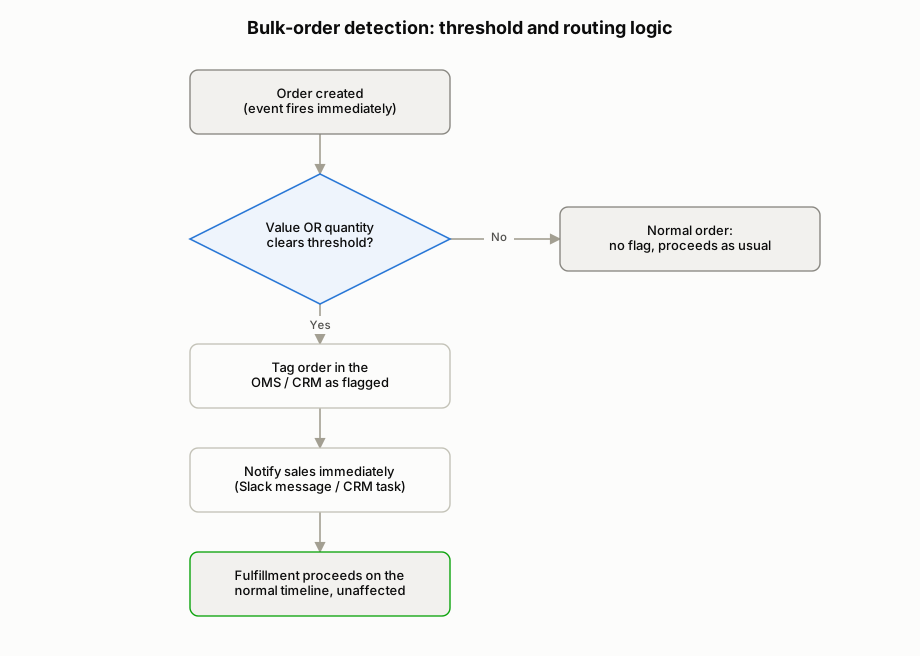
The trigger is order creation. Every new order fires an event, and that event carries the data you need: line item quantities, total order value, sometimes customer metadata like whether this is a first-time buyer or a returning one. The automation listens for that event and does nothing else until it fires, no polling, no scheduled batch job checking the order table every so often.
Threshold logic runs against that event immediately. We'd set two possible triggers, not one: total order value above a set number, or total quantity above a set number, because either one alone misses cases the other catches. A single order for two hundred units of a cheap accessory might not clear a dollar threshold but is obviously not a normal consumer purchase. A single order for three of the most expensive item in the catalog might clear the dollar threshold on unit count alone. An "or" condition between the two catches more of the real cases than either threshold running alone.
When an order clears either threshold, two things happen in parallel. First, the order gets tagged, inside whatever system holds it (order management platform, CRM, wherever sales actually looks), so anyone opening it later sees immediately that this was flagged, not stumbled into by chance. Second, a notification goes out the moment the threshold is crossed: a Slack message to a sales channel, a task created in whatever CRM the team uses, something that shows up somewhere a person will actually see it within minutes, not something that sits in an unread report.
Everything else about the order proceeds exactly as normal. Payment processes, fulfillment queue picks it up, shipping happens on the regular timeline. The automation adds a signal on top of the existing flow, it doesn't intercept or delay the order itself. That separation matters: the buyer still gets their chairs on schedule whether or not sales ever follows up, and a false positive costs nothing more than an unnecessary Slack ping.
What this actually solves, and what it doesn't
This closes the "nobody happened to notice" gap. That's real and it's the core of the problem. But it introduces its own set of tradeoffs, and pretending otherwise would be dishonest.
Threshold tuning is genuinely tricky, not a one-time setting. Set it too low and sales gets pinged on every slightly-larger-than-average order, most of which are just someone stocking up for a big family or buying gifts for a wedding party, not a wholesale lead. That kind of noise trains people to ignore the channel, which defeats the whole point. Set it too high and you miss real opportunities, because wholesale-sized orders for a smaller catalog item might never clear a threshold calibrated around your bestselling armchair.
It also doesn't fix a slow sales team. The automation gets the alert to a human fast. What that human does with it is entirely outside the automation's control. If the same team that took two days to notice an order in a report also takes two days to reply to a Slack ping, the speed advantage evaporates, just later in the process. This is a routing fix, not a responsiveness fix, and treating it as the whole solution would be a mistake.
There's also a real risk of misreading a legitimately personal order as a business lead. Someone buying furniture for three vacation rentals they personally own, or a large gift order for an entire extended family, can clear the same threshold as a genuine wholesale inquiry. A sales rep who cold-calls a private customer with a wholesale pitch creates a strange, slightly awkward interaction, not a disaster, but not nothing either. The alert should probably read as "worth a look," not "confirmed lead," and whoever handles it needs enough judgment to tell the difference on the first message.
The practical shape of it
Mechanically, this is a fairly small build. An order-creation webhook or event from the storefront platform, a threshold check (value or quantity, evaluated with an "or" condition), a tag written back to the order record, and a notification fired to wherever the sales team actually looks, a Slack channel, a CRM task, an email to a specific inbox, whatever's already part of the team's daily habits rather than a new tool they have to remember to check. The normal fulfillment path doesn't touch this automation and isn't touched by it. If the automation broke entirely tomorrow, orders would still ship on time, they'd just go back to being noticed by chance instead of by design.
What the delay actually costs
The number worth citing here is a stat that traces back to a 2007 MIT and InsideSales.com study of inbound B2B leads: a lead contacted within five minutes is roughly 21 times more likely to qualify than one contacted after thirty minutes. It's cited constantly in speed-to-lead research, Kixie's included, but it originated with that MIT study, not with any single vendor. Worth being precise about that, since it gets repeated so often the original source tends to fall off.
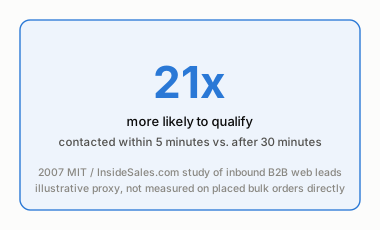
It's also worth being precise about what that study actually measured: unqualified inbound web leads, people who filled out a form expressing interest, not an order that's already been placed and paid for. A bulk order sitting in a D2C queue is a different situation than a cold web lead, the buyer has already committed money, which arguably makes them a warmer prospect, not a colder one. So the 21x figure is illustrative here, a reasonable proxy for how much speed matters in buyer intent generally, not a direct measurement of this specific scenario. We haven't found a study that measures response-time impact specifically on already-placed bulk orders in a consumer storefront, and until one exists, that's a real gap rather than something to paper over with a made-up number.
What isn't a gap is the logic underneath it: a large order sitting unanswered for two days is exactly the kind of situation where buyer patience is shortest and competitive alternatives are easiest to reach. The five-minute number may not transfer exactly, but the direction it points in does.
Where this shows up
Documented in home goods, where bulk orders for staging, hospitality, or interior design projects show up regularly inside an otherwise consumer-facing store. It's not limited to that category. Anywhere a D2C brand occasionally gets B2B-sized orders through its normal storefront, bulk gifting, corporate orders, wholesale inquiries that never went looking for a separate wholesale channel, the same gap exists. The size of the order is the signal. Whether anyone sees that signal in time is a design choice, not a matter of luck, once you decide to treat it as one.