This is one of the more category-agnostic automations in ecommerce. Beauty, fashion, food and beverage, health, home goods: the checkout page doesn't care what's in the cart, and neither does the customer's attention span. We've seen the same pattern repeat across every vertical we've looked into.
A founder's story
We went looking for a real, verbatim quote from a named founder describing this specific pain: the moment they realized carts were dying quietly and nobody was catching them. We checked podcast transcripts (Shopify Masters, My First Million), Starter Story interviews, Indie Hackers threads, and founder interviews tied to cart-recovery tools like Carthook and Cartloop. What turned up was plenty of founders talking about cart recovery tactics (timing, copy, discount ladders) after they'd already solved the problem, but nothing verbatim and sourced about the "before" moment, the actual felt frustration of watching carts pile up unattended.
Here's a pattern that shows up repeatedly across founder interviews about early-stage ecommerce operations, not tied to any one person.
A small team is three months into running their own Shopify store. Someone on the team, usually the founder, has a rough mental habit of opening the "abandoned checkouts" tab in Shopify admin every few days, scanning it, and manually emailing anyone who looks like a serious near-miss (big cart, recognizable name, checked out before). It works, sort of, for the first few weeks. Then order volume creeps up, the founder gets pulled into fulfillment or a marketing push, and the tab stops getting opened. Nobody decided to stop recovering carts. It just stopped being the most urgent thing in the room, every single day, until it was quietly not happening at all.
That's the shape of it, even without a name attached. It's less a crisis and more a slow leak that nobody schedules time to look at.
Elaborating the pain
The reason "just check the abandoned checkout list" doesn't scale isn't a discipline problem. It's a timing and attention problem, and both get worse as the business grows, not better.
First, timing. A nudge sent within the hour has a real shot at catching someone while the product is still on their mind. A nudge sent three days later is competing with everything else that's happened in that person's life since. A manual process, run by a human with other jobs, structurally cannot hit the one-hour window consistently. Even a disciplined operator checking the list twice a day is already too slow for the highest-value window.
Second, attention. Checking a list "when I remember" is a habit that decays under load, not because the person stops caring about recovering revenue, but because on any given day, other things are more visibly urgent: a shipping delay, a return request, a supplier call. Abandoned carts don't complain. They don't escalate. They quietly disappear from the list of things anyone is thinking about, which makes them exactly the kind of task that gets deprioritized without ever being explicitly deprioritized.
Third, the real cost isn't the time spent checking the list. It's the opportunity cost of the checks that don't happen. A founder spending fifteen minutes a day on this is spending it on a task a system can do continuously, at the correct moment, without needing to be remembered. That's not a knock on the founder. It's a bad allocation of the one resource a small team never has enough of.
What a solution could look like
There's a real range of ways brands actually handle this, and it's worth being honest about what each one solves and doesn't.
Doing nothing is more common than people admit, especially for very early-stage stores. The cost is straightforward: recoverable revenue goes unrecovered, with no visibility into how much.
The platform default is the most common state for brands doing meaningful volume. Shopify has a native abandoned checkout email, Klaviyo ships a pre-built abandoned cart flow template, and the automation exists, technically, though it's usually never been touched since someone turned it on. It solves the "nothing is happening" problem. It doesn't solve timing, personalization, or channel coverage, because a default is built to be generic enough to work for every store, which means it's tuned for nobody in particular.
A dedicated point tool (SMS-focused platforms, multi-channel recovery services, human-assisted texting) goes further: better timing logic, multi-channel reach, sometimes a person actually texting back. The tradeoff is another subscription, another dashboard, and another system that needs to stay synced with your inventory and order data, or it starts sending nonsense, a "still interested?" text for an item that's already sold out, for example.
Hiring someone to do it manually is rare, but it happens at brands with enough cart volume to justify a person whose job includes reaching out to high-value abandoners personally. This can outperform automation for genuinely high-ticket items where a real conversation changes the outcome. It doesn't scale below a certain order value, and it depends entirely on that person's consistency.
A fully custom automation, built against your platform's actual data, catalog, and customer segments, is the version covered in the next section. It's not inherently better than a good dedicated tool. The advantage is control: exactly what triggers it, exactly what stops it, exactly how it reads inventory and order state before deciding to send anything.
The solution we'd build
Here's how we'd build this if we were setting it up from the platform's raw data rather than relying on a vendor's black box.
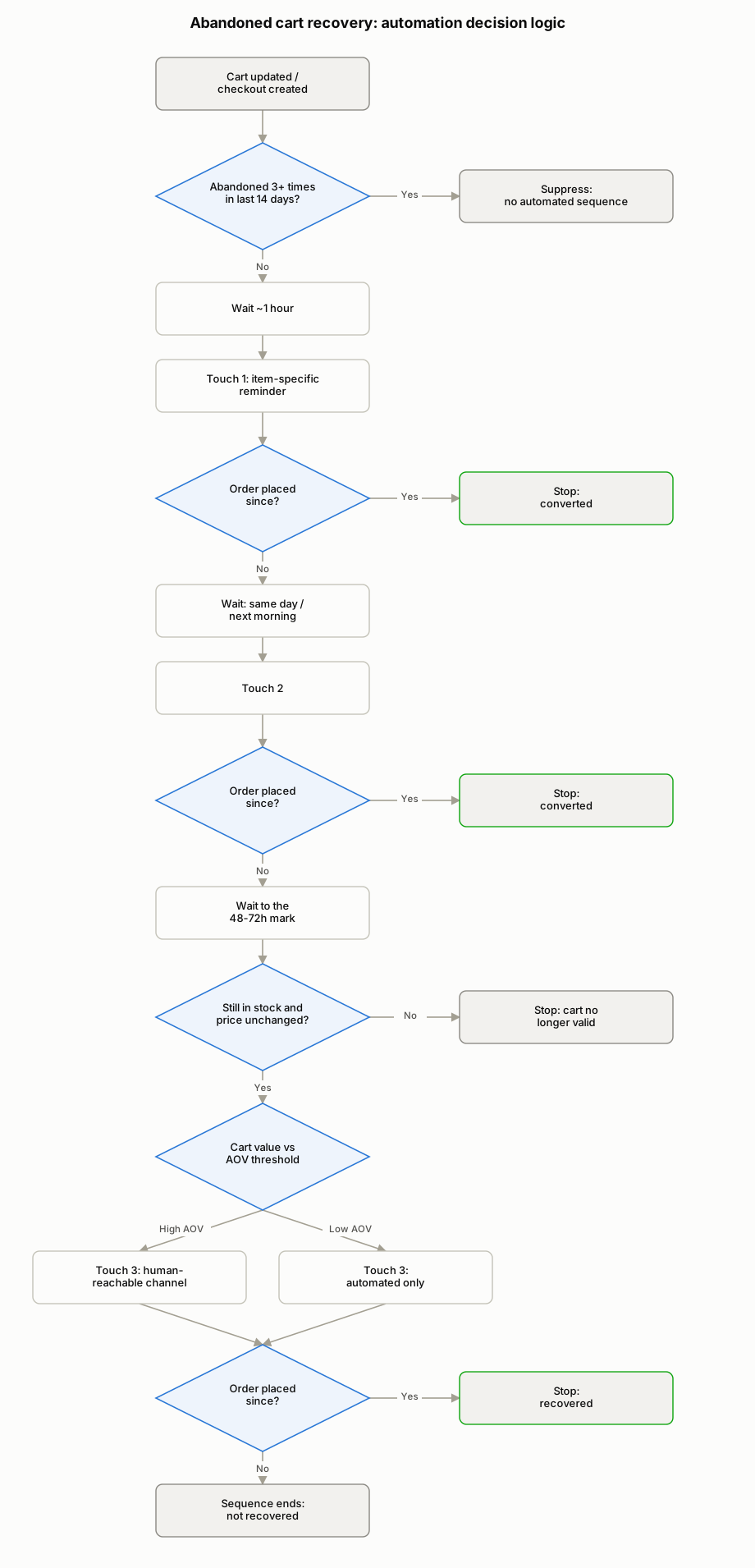
The trigger is a checkout_created or cart_updated webhook from the ecommerce platform, not a polling job that checks a list on a schedule. Polling introduces exactly the lag problem this is supposed to fix. The moment a cart is updated and the session goes quiet, that event should land in the orchestration layer immediately.
From there, a wait state starts, not a single wait, a sequence of them. First touch at roughly one hour: short, low-pressure, mentions the specific items left behind (pulled from the cart line items, not a generic "you left something" line). Second touch later that day or the next morning, depending on cart value. A third touch at 48 to 72 hours only if the first two haven't converted and the cart is still valid, meaning the items are still in stock and the price hasn't changed out from under the customer.
The stopping condition matters more than the sending logic. Before every single send in the sequence, the system re-checks order status against the platform. If an order exists for that customer and cart, the sequence halts immediately, full stop, no exceptions. This is the part that's easy to get wrong and embarrassing when you do: nothing kills trust in a "smart" automation faster than a recovery email landing in someone's inbox for an order they already completed twenty minutes ago.
We'd also branch by AOV. A $40 cart and a $400 cart shouldn't get the same message. High-value carts might route to a channel with a human option (a text a person can actually reply to) rather than a fully automated email-only sequence, since the conversion math on a high-ticket cart can justify a bit of manual attention that a $40 cart can't.
One more thing we'd build in from day one: a suppression list. Anyone who's abandoned three carts in the last two weeks without converting is telling you something, maybe price sensitivity, maybe they're just a browser. A fourth aggressive nudge reads as noise, not recovery, and it's the fastest way to train a customer to ignore your emails entirely.
Pros and cons
The upside is straightforward: consistent timing, no dependency on a human remembering to check a list, and a system that scales with order volume instead of degrading under it. Once it's built and stable, it runs at 2am the same way it runs at 2pm, which a person checking a dashboard cannot do.
The honest cons matter just as much, and they don't get said enough.
This is almost certainly already live somewhere in your stack, in some basic form, so the real value of most of this work sits in tuning what's already there rather than building from scratch. A brand that skips straight to "let's build a custom recovery system" without first auditing the platform default is often solving a problem that's half-solved already, just tuned badly.
False positives are a real risk. If the stopping-condition check has any lag or the webhook drops an event, a customer gets chased for something they already bought. That's the single most common failure mode in cart recovery builds, and it's the fastest way to make an automation feel broken even when it's converting well on average.
There's an ongoing upkeep burden that's easy to underestimate at build time. Product prices change, items go out of stock, promotions start and end, and a recovery message referencing a price or availability that's no longer true isn't just unhelpful, it damages trust. The system needs a live read on inventory and pricing, not a cached snapshot from whenever it was built.
It also depends entirely on clean platform data and reliable webhooks. If checkout events are inconsistent, delayed, or missing fields, the whole sequence rests on a shaky foundation, and no amount of clever copy fixes a system triggering on bad data.
And there's a real risk of over-messaging. Three touches in three days feels reasonable to the person building the system. It can feel like a lot to the person receiving it, especially if they're already getting welcome flows, post-purchase flows, and a newsletter from the same brand. Recovery sequences don't run in isolation; they compete with everything else in someone's inbox from the same sender.
How it gets implemented
The trigger source is the platform's checkout and order webhooks (Shopify's checkouts/create and checkouts/update, or the equivalent on whatever platform is in use), feeding into an orchestration layer that manages timing, branching, and the stopping-condition checks. We'd run that orchestration in something like n8n rather than hand-rolling the timing logic in platform-native tools, mainly because it makes the wait states, conditional branches, and re-verification checks visible and editable rather than buried in a vendor's flow builder.
The knowledge the system needs to reference (current inventory, current pricing, order status) should come from a live API call at send time, not a cached copy taken when the cart was first abandoned. This is the same principle as grounding a support reply in the actual return policy rather than what a model assumes it probably is: check reality at the moment you're about to act on it, not at the moment you started thinking about acting.
What still needs a human: reviewing performance by segment periodically (is the third touch actually converting, or just costing deliverability reputation for no return), auditing the suppression list logic every so often so it's not accidentally suppressing genuinely interested repeat browsers, and spot-checking that the stopping condition is actually catching completed orders in real time, not on a delay. None of that needs to happen daily. It does need to happen on a schedule, which is really the same lesson as the underlying problem: things that don't get scheduled quietly stop happening.
KPIs: the cost of the pain, and the cited improvement
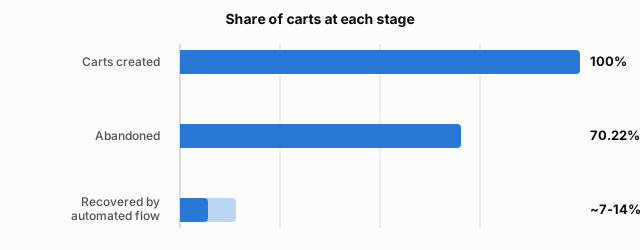
The scale of the underlying problem is well documented. Baymard Institute puts the average documented online shopping cart abandonment rate at 70.22%, averaged across 50 separate studies on the subject. That number has held roughly stable for close to two decades, which says something about how structural this problem is rather than how fixable it's ever been in one pass.
On the recovery side, Sendtric's 2026 abandoned cart recovery benchmark cites a figure of 10 to 20% of otherwise-lost cart revenue recovered by automated flows. Worth flagging directly: this is a secondary citation, Sendtric attributes the number to Convertcart rather than running its own study, so treat it as a reasonable industry range rather than a precise, independently verified figure.
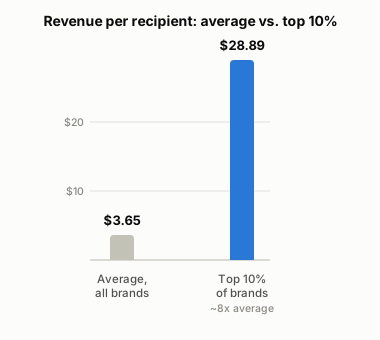
Klaviyo's own benchmark data, drawn from an analysis of over 143,000 abandoned cart flows sent in 2023, is a more direct, primary-source data point: average revenue per recipient across all sends was $3.65, while the top decile of performing brands reached $28.89 per recipient, close to eight times the average. That gap between average and top-decile performance is really the whole argument for tuning over building from scratch: the mechanism is already common, the difference between a mediocre version and a strong one is almost entirely in the details (timing, segmentation, the stopping condition, whether the copy addresses why someone actually left).
None of these numbers are a guarantee for any specific store. Recovery rate depends heavily on average order value, category, existing email and SMS reputation, and how good the underlying flow already is before anyone touches it. But the range is wide enough, and the underlying abandonment rate large enough, that for a brand doing meaningful cart volume, the gap between a default flow and a well-tuned one is rarely trivial money.